

Media2URL vs ImageToURL.cloud: Free Image Hosting and Asset Management

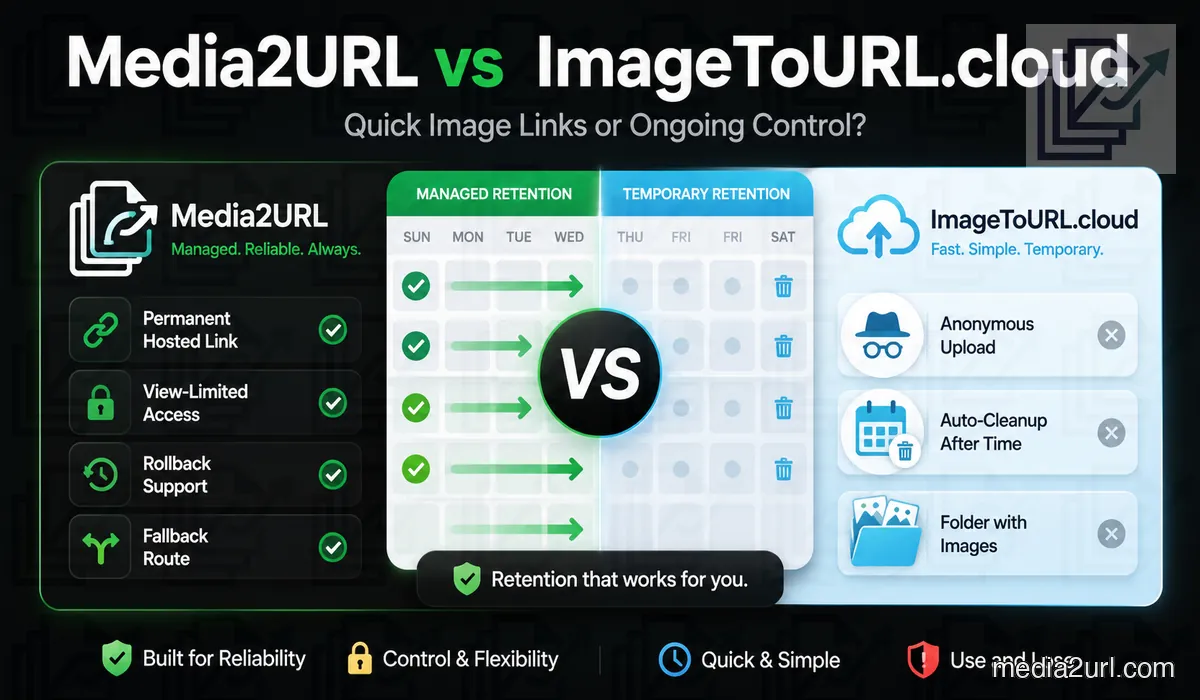
Anonymous image hosting can solve a small sharing problem within seconds. You upload a screenshot, copy its direct URL and paste it into a forum, chat message or document.
The difficult part appears later. The link may follow a cleanup schedule, and an anonymous user may not have a dashboard where the uploaded file can be found again.
ImageToURL.cloud handles this by separating temporary guest uploads from signed-in uploads that can be marked for long-term retention. Media2URL takes a different approach. The uploaded file can stay inside a workspace where it is organised, edited or replaced later. Supported images can also provide another website size or format through URL transformations without uploading a separate copy each time.
The better choice depends on what should happen after the first link is copied.
Quick answer
Choose ImageToURL.cloud when you mainly need a free image URL, anonymous uploading, original-quality delivery or a quick local batch upload. Its guest workflow is especially useful when the image only needs to remain online for a short period.
Choose Media2URL when the file will still need work after the first link is created. It can remain inside a managed workspace with folders, editing, file history, team roles and supported access controls.
Media2URL also handles supported PDFs, videos, GIFs and audio files. That makes more difference when you are managing an ongoing website or client project rather than sharing one image.
ImageToURL.cloud guest uploads
ImageToURL.cloud allows a visitor to upload without creating an account.
The current Starter allowance provides five temporary uploads during a rolling 24-hour period. Each file can be up to 50 MB.
| Guest feature | Current allowance |
|---|---|
| Account required | ✕ No |
| Temporary uploads | 5 per rolling 24 hours |
| Maximum file size | 50 MB |
| Retention | Until the monthly cleanup |
| Minimum expected availability | Around two weeks |
| Dashboard history | Not included |
| Permanent option | Not available to guests |
Guest links are useful for files that only need to remain online for a short period. The owner should keep the original file because the hosted copy will eventually be removed through the normal cleanup process.
The service does not promise one exact deletion date for every guest file. A link may remain for longer than two weeks depending on when it was uploaded within the cleanup cycle.
Signed-in uploads
A free account changes the retention workflow.
Signed-in users can currently create up to 50 permanent uploads each day. They can also make unlimited temporary uploads under the published account rules.
The uploader includes a Never delete option. It needs to be selected before upload when the file should be excluded from the normal temporary-cleanup workflow.
| Signed-in feature | Current allowance |
|---|---|
| Permanent uploads | 50 per day |
| Temporary uploads | Unlimited |
| Maximum file size | 50 MB |
| Dashboard history | Included |
| Search | Included |
| Never-delete option | Included |
| Self-service paid plan | Not currently offered |
ImageToURL.cloud does not currently offer a normal self-service paid subscription. Users who need higher limits are asked to contact the service for a manual review.
A signed-in link marked Never delete is more suitable for a blog post, documentation page or product listing than an anonymous temporary link.
Supported formats
The main ImageToURL.cloud uploader focuses on direct image hosting. Its published image formats include:
- JPG
- PNG
- WebP
- GIF
- SVG
Some parts of the current uploader also reference MP3 support, although the main product remains focused on image hosting.
HEIC and PDF files are handled through separate browser conversion tools before the resulting supported file is uploaded.
Media2URL supports a wider hosted-file library. Images, videos, GIFs, PDFs, audio files and general downloadable documents can remain inside the same workspace.
Original-quality image delivery
ImageToURL.cloud says hosted images are delivered without recompression, resizing or an added watermark.
This is useful when the exact original file should remain unchanged. A high-resolution PNG, animated GIF or design export can be shared without the service creating a smaller copy first.
Its direct URLs end in the actual image extension. This makes them suitable for HTML image tags, CSS backgrounds, Markdown and forum embed codes.
Media2URL can also keep the original asset, but it gives the owner another option when the website needs a different output. A supported image can be delivered at another size, crop or format through URL transformations without changing the stored master file.
The original and optimised workflows serve different needs. One preserves the uploaded file exactly, while the other can prepare a suitable delivery version for a website layout.
Bulk uploads
ImageToURL.cloud already provides a capable bulk uploader.
A user can select several local images together or drag an entire folder into the upload area. Each accepted file receives a separate direct URL.
The final links can be copied together and pasted into a spreadsheet, document or content-management workflow.
| Bulk upload feature | ImageToURL.cloud |
|---|---|
| Multiple local files | Supported |
| Folder selection | Supported |
| Mixed image formats | Supported |
| Maximum size | 50 MB per file |
| Link output | One direct URL per file |
| Copy all links | Supported |
| Full-quality delivery | Supported |
| Guest retention | Temporary |
| Signed-in retention | Permanent when selected |
ImageToURL.cloud already handles local bulk uploading well. The difference appears after those files have been uploaded and need to be organised or managed again.
A temporary forum-image example
A user wants to post a screenshot inside a troubleshooting forum.
The screenshot should remain useful for one week. The user does not need analytics, editing tools or a dashboard.
An ImageToURL.cloud guest upload may complete the task. It requires no registration and should remain available until the next monthly cleanup.
Media2URL would not provide much extra value for a disposable image with no continued management requirement.
The decision changes when the screenshot becomes part of a tutorial that should remain online for several months. The user should sign in and choose permanent retention or use a managed hosting workflow with a direct image link.
When the image changes after publication
A file can remain online for years and still become outdated. A product photograph may change, a screenshot may need correcting or a new logo may replace the old one.
ImageToURL.cloud's Never delete setting deals with retention. It tells the service not to remove the selected upload through the normal cleanup workflow. Its current public pages do not present same-URL replacement with a visible version timeline as a central feature.
Media2URL handles the revision itself. A supported replacement can become the active asset while the managed URL remains in use.
Earlier supported versions remain in file history. If the replacement was wrong, the owner can return to an earlier version instead of finding every page where the link was already used.
This becomes useful for product photographs, software screenshots, client graphics and documents that receive regular revisions.
ImageToURL.cloud may still be the simpler option for a finished image that is unlikely to change.
Link Doctor checks what an existing URL actually returns
A URL can open normally in your browser and still fail when another website or application tries to use it.
Media2URL Link Doctor checks the HTTP response and follows redirects so you can see where the address finally ends. The returned content type can also show whether an image-looking URL reaches a real media file or an HTML page.
CORS matters when the file needs to be used through browser scripts or inside a canvas-based tool. An image may display normally but still be blocked when JavaScript tries to work with it.
For video and audio URLs, Link Doctor can also test byte-range behaviour. Media players often depend on partial-content responses when someone jumps to another point in the file.
The tool does not make a private file public or bypass another service's permissions. It simply helps you understand what the reachable address is returning.
| Check | Why it matters |
|---|---|
| HTTP status and redirects | Shows whether the request works and where it ends |
| Content type | Shows whether the URL returns media or a webpage |
| CORS | Helps explain browser-script and canvas problems |
| Byte-range support | Helps diagnose video and audio seeking |
Local bulk upload and remote migration
ImageToURL.cloud is a good fit when the files are already on your computer. You can select multiple images or an entire folder and receive the direct URLs together.
Media Migration starts from a different situation. The files may already live on another host or inside supported cloud storage, and you want them moved into the Media2URL library.
Supported migration jobs can work with groups of source URLs or available S3-compatible storage. Duplicate checking helps when the source library contains the same file more than once.
Where source-to-new-URL mapping is available, the migration result can also preserve the relationship between the old address and its new Media2URL URL.
This is useful when an existing website or spreadsheet still contains the older links.
The migration process does not bypass passwords, private accounts or storage permissions. You still need to own the files or have permission to host another copy.
Media2URL library organisation
A list of direct URLs may be enough for occasional image sharing. A business library usually needs more structure.
Media2URL supports nested folders. Files can be moved between folders and grouped according to a client, project or content type.
Tags help users find related assets without depending only on filenames. Bookmarks provide quick access to files used regularly.
Search can filter the library by filename, tag or media type. Several selected assets can also receive the same folder, visibility or expiry update.
ImageToURL.cloud provides dashboard history and search for signed-in users. Media2URL adds a more structured folder and workspace system for larger asset collections.
Team workspaces
Media2URL lets several people manage the same asset library without sharing one login.
Each workspace keeps its own files, folders, settings and members separate. An agency can create one workspace for every client.
| Workspace role | Main responsibility |
|---|---|
| Owner | Full access, billing and workspace deletion |
| Admin | Member and workspace management |
| Editor | Uploading, editing and organisation |
| Viewer | Browsing files and copying approved links |
Members receive access through secure email invitations. Pending invitations can be cancelled or sent again.
Workspace audit logs record important actions such as uploads, renaming, metadata changes and role updates. The records can be exported as CSV for an internal review.
ImageToURL.cloud is focused more on personal upload history. Media2URL has a stronger workflow when several people need controlled access to the same library.
Browser image editing
ImageToURL.cloud provides direct hosting without compressing or changing the image. Users who need format changes can use its browser conversion tools.
Media2URL includes a canvas Image Editor inside the asset library.
A user can adjust brightness, contrast, saturation and sharpness. Blur, opacity, grayscale and colour-temperature controls are also available.
The crop tool supports free-form and fixed aspect ratios. A straightening control can correct a tilted photograph.
Text, freehand drawing and vector shapes can be added over the image. Each item remains on a separate layer that can be hidden, locked or reordered.
| Editing requirement | ImageToURL.cloud | Media2URL |
|---|---|---|
| Original-quality hosting | ✓ Available | Original remains available |
| Browser format conversion | Separate browser tools | Export controls inside editor |
| Brightness and contrast | Not presented as a core hosting feature | Available |
| Crop controls | Available through related tools | Built into asset editor |
| Drawing and shapes | Not presented as a core feature | Available |
| Text layers | Not presented as a core feature | Available |
| Layer management | Not presented as a core feature | Available |
| Compare with original | Not presented as a core feature | Interactive comparison |
| JPEG, PNG and WebP export | Depends on selected tool | Available |
The edited result can replace the active version or remain as a separate asset. This allows the user to preserve the original while publishing a prepared copy.
When the image is already correct
A visual editor is useful when the image itself needs changing. A different workflow is needed when the content is already correct but the website needs another size.
Supported Media2URL images can use URL transformations for width, height, fit, crop position and quality. WebP or AVIF can also be requested for eligible outputs.
This lets one stored image serve a small card, article image or larger preview without creating a separate manual upload for every layout.
ImageToURL.cloud takes the simpler approach of delivering the original uploaded file unchanged. That is useful when preserving the exact source is more important than generating responsive website variants.
Privacy checks before sharing
An image can contain visible private information and hidden metadata.
Visible information may include a face, phone number or account detail. Hidden EXIF metadata may contain camera settings or GPS information.
Media2URL can inspect supported metadata during the upload workflow. The user can remove unwanted metadata where the browser process supports it.
The image editor can crop, draw over or pixelate visible information.
Neither service should be treated as an automatic privacy guarantee. The final output should be inspected before it is shared publicly.
PDF tools
ImageToURL.cloud is mainly an image-hosting service. Its pages direct PDF and unsupported image-format workflows through browser conversion tools.
Media2URL can host the PDF directly and also provides a visual PDF workspace when the document needs changes before sharing.
PDFs can be merged or split, while pages can be moved into another order through the page organiser. Watermarks and page numbers are available for supported workflows.
Other controls cover compression, passwords and metadata. PDF pages can also be exported as images, while image files can be combined into a new PDF.
| PDF requirement | ImageToURL.cloud | Media2URL |
|---|---|---|
| Direct PDF hosting | Not the main image-hosting workflow | Available |
| Merge and split | Browser conversion workflow | Available |
| Page organisation | Not presented as a document-editing feature | Available |
| Watermarks and numbering | Not presented as a document-editing feature | Available |
| Compression and passwords | Not presented as a document-editing feature | Supported controls available |
| PDF/image conversion | Separate conversion workflow | Available |
ImageToURL.cloud remains suitable when an image should be converted before hosting. Media2URL fits users who want the PDF to remain a managed document asset.
Video, audio and GIF tools
ImageToURL.cloud’s core workflow focuses on images. Some uploader text also lists MP3 support.
Media2URL provides separate processing workspaces for video, audio and GIF files.
A video can be compressed for web playback or trimmed to a chosen section. A clip may be converted into an animated GIF.
The audio track can be extracted as MP3. Existing audio files can be trimmed and converted between supported formats.
GIF files can have their playback speed changed or frame order reversed. Colour optimisation can reduce the final size.
These are practical processing tools rather than a replacement for professional desktop editing software.
Original files versus responsive image variants
ImageToURL.cloud keeps the delivery model simple. The uploaded image is served in its original quality without forced resizing or recompression.
That can be useful for design files, large screenshots or images where the exact original output matters.
Media2URL can also keep the original file. For supported images, another version can then be requested through the delivery URL when the website needs a different size or format.
Width, height, fit and crop position control the shape of the result. Quality can be adjusted, and WebP or AVIF can be requested where supported.
The two approaches solve different problems. Original delivery preserves the source exactly. URL transformations help when the same image has to fit several website layouts.
Activity and usage information
ImageToURL.cloud provides upload history and search for signed-in users. Its public pages do not present detailed traffic analytics as a main part of the hosting workflow.
Media2URL's Insights workflow focuses on activity around hosted files and workspace usage. Depending on the current plan, it can show share-page views, recent download and bandwidth totals, workspace quota use and the shared links receiving the highest recorded view counts.
Workspace audit logs serve a different purpose. They record actions made inside the workspace, such as uploads, file changes or member updates.
These numbers should be treated as operational information rather than a complete visitor-analytics system.
| Information | ImageToURL.cloud | Media2URL |
|---|---|---|
| Upload history | Available when signed in | Available |
| Dashboard search | ✓ Available | Available |
| Share-page views | Not highlighted as a central feature | Available where supported |
| Download and bandwidth totals | Not highlighted as a central feature | Available where supported |
| Workspace quota information | Account usage information where available | Available where supported |
| Member activity history | Personal account workflow | Workspace audit logs |
Access and link lifecycle
ImageToURL.cloud divides links mainly through temporary and permanent retention.
Guest links reach the monthly cleanup. Signed-in users can select permanent storage through the Never delete option.
Media2URL separates file retention from access rules under Security & Access Controls. A supported asset can be Public, Unlisted, Private or Password Protected depending on the current plan and file type.
Expiry, view limits and download limits can be applied where those controls are available. One-time access can also be useful when a file should not remain repeatedly available after the intended opening.
Temporary signed delivery provides another option for private files. The recipient receives a link that works for a limited period instead of a normal unrestricted public address.
If access needs to stop sooner, the available file controls can disable the hosted link without waiting for the normal expiry condition.
| Access requirement | ImageToURL.cloud | Media2URL |
|---|---|---|
| Anonymous temporary link | ✓ Available | Depends on current upload workflow |
| Signed-in permanent link | ✓ Available | Available according to plan |
| Unlisted link | Direct links are unlisted, not private | Explicit Unlisted access |
| Private workspace file | Not presented as a core workflow | Available where supported |
| Password protection | Not presented as a core feature | Available where supported |
| Selected expiry date | Cleanup-based guest expiry | Owner-selected expiry where supported |
| Maximum downloads | ✕ Not described | Download limit where supported |
| One-time view | ✕ Not described | One-time access where supported |
| Signed temporary URL | ✕ Not described | Temporary signed delivery where supported |
Public API status
ImageToURL.cloud currently uses its upload endpoint for the website itself, but a public production API for external applications is not part of the live workflow described in the current documentation.
API-key or bearer-token access should therefore not be treated as a production feature until the service makes that interface publicly available.
Media2URL also does not currently provide a public developer API comparable with a normal application-upload API.
If programmatic uploads are the main requirement, neither service should be selected on the assumption that a public production API already exists. The current comparison is primarily between their browser and dashboard workflows.
Direct comparison
| Requirement | ImageToURL.cloud | Media2URL |
|---|---|---|
| Anonymous uploading | ✓ Available | Depends on current Media2URL workflow |
| Guest upload allowance | 5 temporary uploads per rolling 24 hours | Check the current Media2URL plan |
| Signed-in allowance | 50 permanent uploads daily plus unlimited temporary | Check the current Media2URL plan |
| Maximum file size | 50 MB | Check the current Media2URL plan |
| Guest retention | Monthly cleanup with around two weeks minimum | Owner-selected settings where available |
| Permanent free links | Available when signed in | According to current plan |
| Full-quality delivery | ✓ Available | Original file can remain available |
| Local bulk upload | ✓ Available | Available |
| Folder selection during upload | ✓ Available | Depends on current uploader |
| Copy all URLs | ✓ Available | Available through bulk workflow |
| Dashboard history | Available when signed in | Available |
| Public production API | Not currently available | No public API currently offered |
| Images | Supported | Supported |
| SVG | Supported | Supported |
| GIF | Supported | Supported with processing tools |
| MP3 | Listed in parts of the uploader | Supported with audio tools |
| PDF hosting | Not the main workflow | Available |
| Video hosting | Not the main workflow | Available |
| Image editor | Separate browser conversion tools | Layer-based browser editor |
| On-demand image variants | Original file delivered unchanged; no dynamic transformation workflow | Width, height, fit, crop position, quality and supported WebP/AVIF output |
| PDF processing | Separate conversion workflow | Visual PDF workspace for merge, split, organisation, watermarks, numbering and other supported document changes |
| Video processing | Not presented as a main feature | Compress, trim and convert |
| Audio processing | Limited uploader references | Trim and convert |
| Existing URL diagnosis | No dedicated media-link diagnostic workflow documented | Link Doctor for HTTP status, redirects, content type, CORS and byte-range behaviour |
| Remote URL migration | Local file and folder upload workflow | Media Migration from supported bulk URLs or cloud sources |
| Same-URL replacement | Not described publicly | Available |
| Version rollback | Not described publicly | Available |
| Nested folders | Dashboard history and search | Available |
| Multiple workspaces | Not presented as a main feature | Available |
| Team roles | Not presented as a main feature | Owner, Admin, Editor and Viewer |
| Audit logs | Not presented as a main feature | Available with CSV export |
| Asset analytics | Not highlighted as a main feature | Views, recent downloads, bandwidth, quota use and top-link insights where supported |
| One-time view | ✕ Not described | Available |
| Signed temporary URL | ✕ Not described | Available |
Where ImageToURL.cloud has the advantage
ImageToURL.cloud may be the better fit when:
- You want an image URL without creating an account.
- Original-quality delivery matters more than responsive image variants.
- A local folder or batch of images needs direct URLs quickly.
- Free signed-in hosting with the Never delete option covers your long-term needs.
Its 50 MB file allowance is also generous for a free image-hosting workflow.
The service is particularly useful when the image is already finished and you mainly need somewhere to host it.
Where Media2URL has the advantage
Media2URL becomes more useful when the work continues after upload.
- Images still need editing, URL variants, file replacement or rollback.
- Existing assets need to be moved into a managed library from supported URLs or cloud sources.
- A project includes PDFs, videos, GIFs or audio files alongside images.
- Files need team access, expiry, signed delivery or link diagnosis after the URL has been created.
These features matter when the hosted file stays part of an ongoing website, client project or internal workflow.
They may add very little value to someone who only needs one disposable image link.
Which service should you choose?
If the job mainly ends after the image URL is created, ImageToURL.cloud has a very attractive free workflow.
If the same file will be edited, replaced, moved between projects or shared under different access rules, Media2URL is closer to that job.
The right choice depends on what happens after the link has been copied rather than which service has the longer feature list.
Final verdict
ImageToURL.cloud is a capable free image-hosting service. Guest uploads make casual sharing easy, while signed-in users can choose the Never delete option for files that should stay outside the normal temporary-cleanup workflow.
Its 50 MB file allowance, folder upload and original-quality delivery are genuine strengths.
Media2URL starts with the same basic idea of turning a file into a link, but it keeps more of the later work around that file. An asset can remain inside a workspace where it is edited, transformed into another website variant, replaced later or shared with supported access controls.
Choose ImageToURL.cloud when you want simple image hosting and the file itself is already finished. Choose Media2URL when the asset is likely to change or remain part of a larger managed project.
Neither service needs to be the better option for every upload.
Related comparisons
- Media2URL vs Imgur
- Media2URL vs ImgBB
- Media2URL vs Image2URL
- Media2URL vs Cloudinary
- Media2URL vs ImageKit
Comparison review note: This page was reviewed on August 18, 2026 using ImageToURL.cloud's current public uploader, account information and published developer material together with capabilities available in the current Media2URL platform.
Upload limits, retention rules and feature availability can change. Check the current product information before moving an important or production-facing media library.
Frequently Asked Questions
How long do anonymous ImageToURL.cloud uploads remain available?
Guest uploads remain until the monthly cleanup. The service describes this as at least around two weeks of availability.
How many guest files can be uploaded?
Guests currently receive five temporary uploads during a rolling 24-hour period.
Can signed-in users create permanent links?
Yes. Signed-in users can select Never delete before uploading. Under the current service rules, those files are excluded from the normal temporary-cleanup workflow.
Are signed-in temporary uploads limited?
The current pricing page describes signed-in temporary uploads as unlimited.
What is the maximum ImageToURL.cloud file size?
The current published maximum is 50 MB per file.
Which image formats are supported?
The core image uploader supports JPG, PNG, WebP, GIF and SVG.
Does ImageToURL.cloud compress uploaded images?
Its public pages say images are delivered in their original quality without recompression, resizing or an added watermark.
Does ImageToURL.cloud support bulk uploads?
Yes. Users can select several files or folders and receive one direct URL for each accepted image.
Does ImageToURL.cloud have a public upload API?
Not currently. ImageToURL.cloud uses an upload endpoint for its own website, but the current public documentation does not describe a live external production API for normal third-party application uploads.
Can Media2URL replace an image without changing its link?
Yes. A supported replacement can become the active asset while its managed URL remains in use. Earlier supported versions stay in file history and can be restored if needed.
Can Media2URL edit images?
Yes. Media2URL has a layer-based browser editor for visual changes such as cropping, adjustments, text, shapes and drawing. Supported images can also use URL transformations when only another size, crop, quality level or eligible WebP/AVIF output is needed.
Does Media2URL support PDF files?
Yes. PDFs can be hosted and worked on inside the visual PDF workspace. Supported tools cover merge and split workflows, page organisation, watermarks, page numbering, compression, passwords, metadata and conversion between PDF pages and images.
Which service is suitable for a temporary forum screenshot?
ImageToURL.cloud guest uploading may be suitable when the screenshot only needs to remain available for a short period and no dashboard is required.
Does Media2URL change the original image?
Not necessarily. The original asset can remain in the library while another edited copy or URL-based image variant is used for the website. This is useful when you want to preserve the source file but still need smaller or differently formatted delivery versions.