Choose this when the issue is still visible on your screen. The browser asks for permission first, then Media2URL captures one still frame from the screen, window or tab you selected.
Screenshot to URL for Quick Sharing
Something breaks on screen, you take a screenshot, and then the support form asks for a URL instead of another attachment. Screenshot to URL is useful in that exact situation. You can capture one still frame from a full screen, an application window, a browser tab or another source offered by the browser. In fact a screenshot that is already saved on your device can be used here too.
The browser asks for permission before a new capture begins. After you choose what to share, Media2URL takes one still frame and the screen sharing session ends. That screenshot then gets its own URL, which can be pasted into a support ticket or review conversation without taking the same picture again.
If you already have a normal image and do not need any screen capture, keep the existing link to Image to Link.

Click the button below to select a screen, window, or tab to capture. Your screenshot will be automatically uploaded.
Your browser shares a view long enough to capture one frame
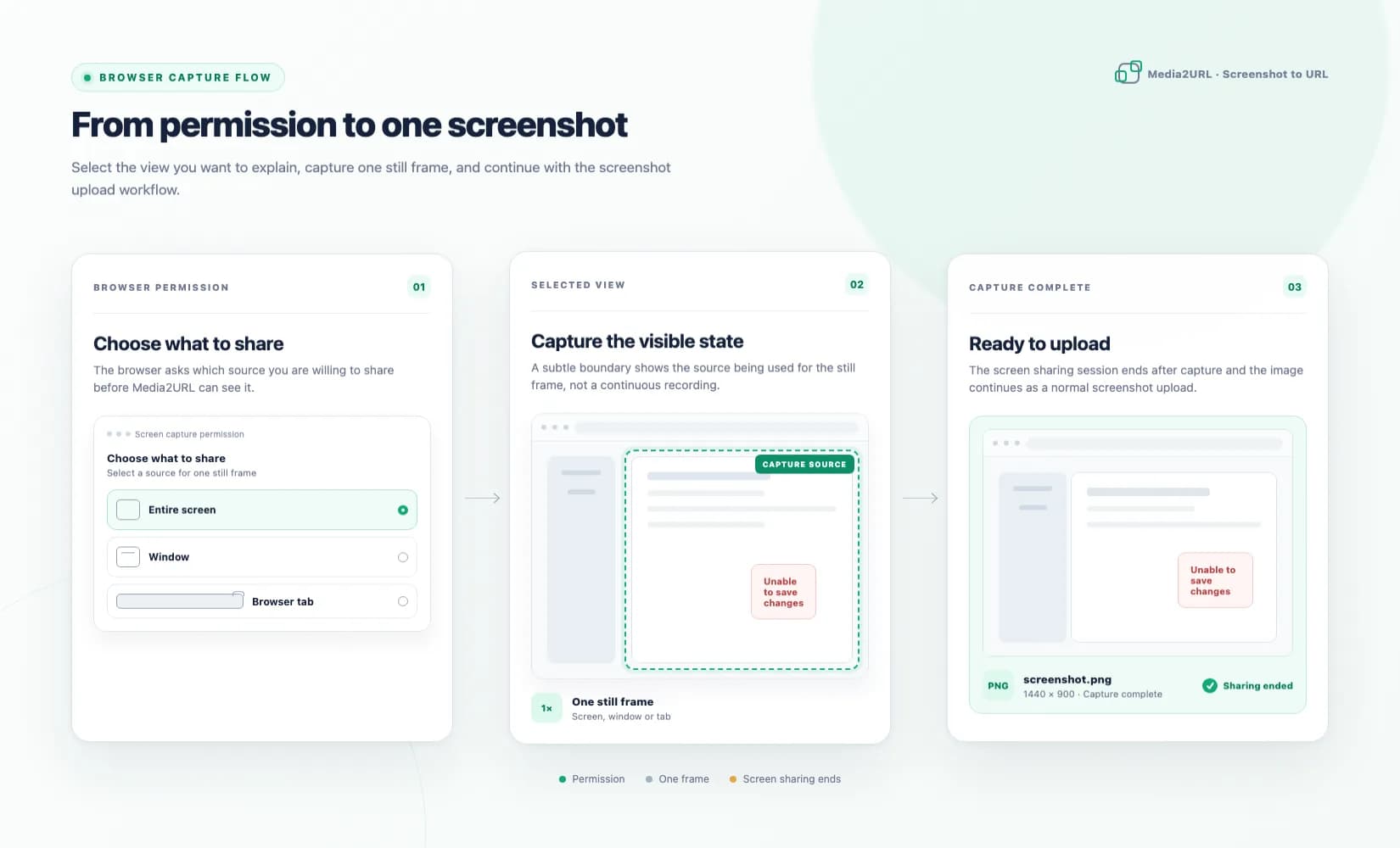
When you choose Start Screen Capture, the browser first asks what you are willing to share. Depending on browser support, that may be a full screen, an application window or a browser tab. Media2URL cannot see the selected view until you approve that browser prompt.
After you choose the source, the tool captures one still frame and prepares it as the screenshot used for the upload. The screen sharing session ends after that capture, so this workflow is different from continuous screen recording.

Your screenshot and sharing outputs stay together
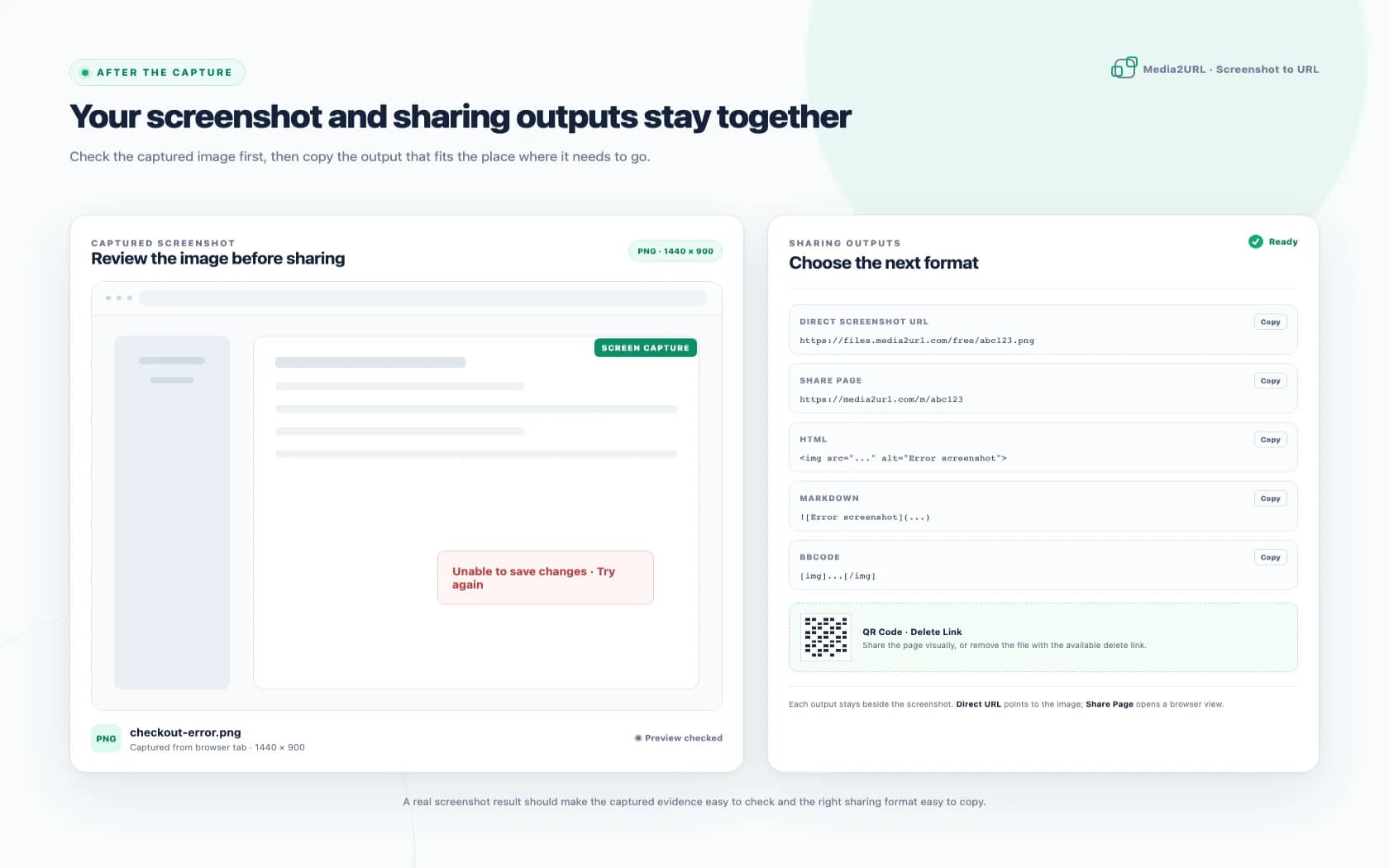
Once the captured frame or saved screenshot finishes uploading, the result panel keeps the preview and available screenshot links together. You can check the image first, then copy the output that fits the place where the screenshot needs to go.
The direct screenshot URL points to the hosted image itself. The share page is usually easier when another person should open the screenshot in a normal browser before deciding whether they need the original file.
The captured image is prepared as a PNG before it enters the normal upload flow.
Privacy and expiry selectors stay close to the upload controls, subject to account availability.

Capture the screen now or use a screenshot you already saved
Choose this when the screenshot already exists on your device. Select or drop the saved file and continue with the privacy or expiry options available for the upload.
A screenshot link often becomes evidence for another conversation
A screenshot is usually captured because something needs to be explained somewhere else. That might be a support ticket, a developer discussion or a design review where the other person needs to see the exact state of the screen.
The useful output depends on that destination. A human reviewer may prefer the share page, while documentation or a forum that accepts image markup can use one of the generated formats shown after the upload.
Problem appears
checkout-error.png
A small error is still visible
Capture evidence
Browser tab captured
One still frame, not a recording
Choose destination
Support ticket
The case needs visual context
Send
Share Page
Open it in a normal browser
Case resolved
Review expiry or access
Keep the evidence only as long as needed
Checkout could not be completed
Show the smallest screen, window or browser tab that gives the other person enough context.
Markdown · 
BBCode · [img]https://files.media2url.com/free/abc123.png[/img]
Teams handling repeated customer issues can also see the Support Teams workflow for organising screenshots and other case files.
The screenshot can leave the tool in more than one form
A bare screenshot URL works when the destination asks for an image address, but forums and documentation tools may expect markup instead. The result panel keeps those formats beside the uploaded screenshot so you can copy the value that belongs in the next workflow.
https://files.media2url.com/free/abc123.pngCopyhttps://media2url.com/m/abc123Copy<img src="..." alt="Error screenshot">CopyCopy[img]...[/img]CopyShare page QRCopyhttps://media2url.com/delete/abc123CopyEach output field has its own copy control. If clipboard permission is refused, select the visible value and use the browser's normal copy command.

Look beyond the part of the screen you meant to show
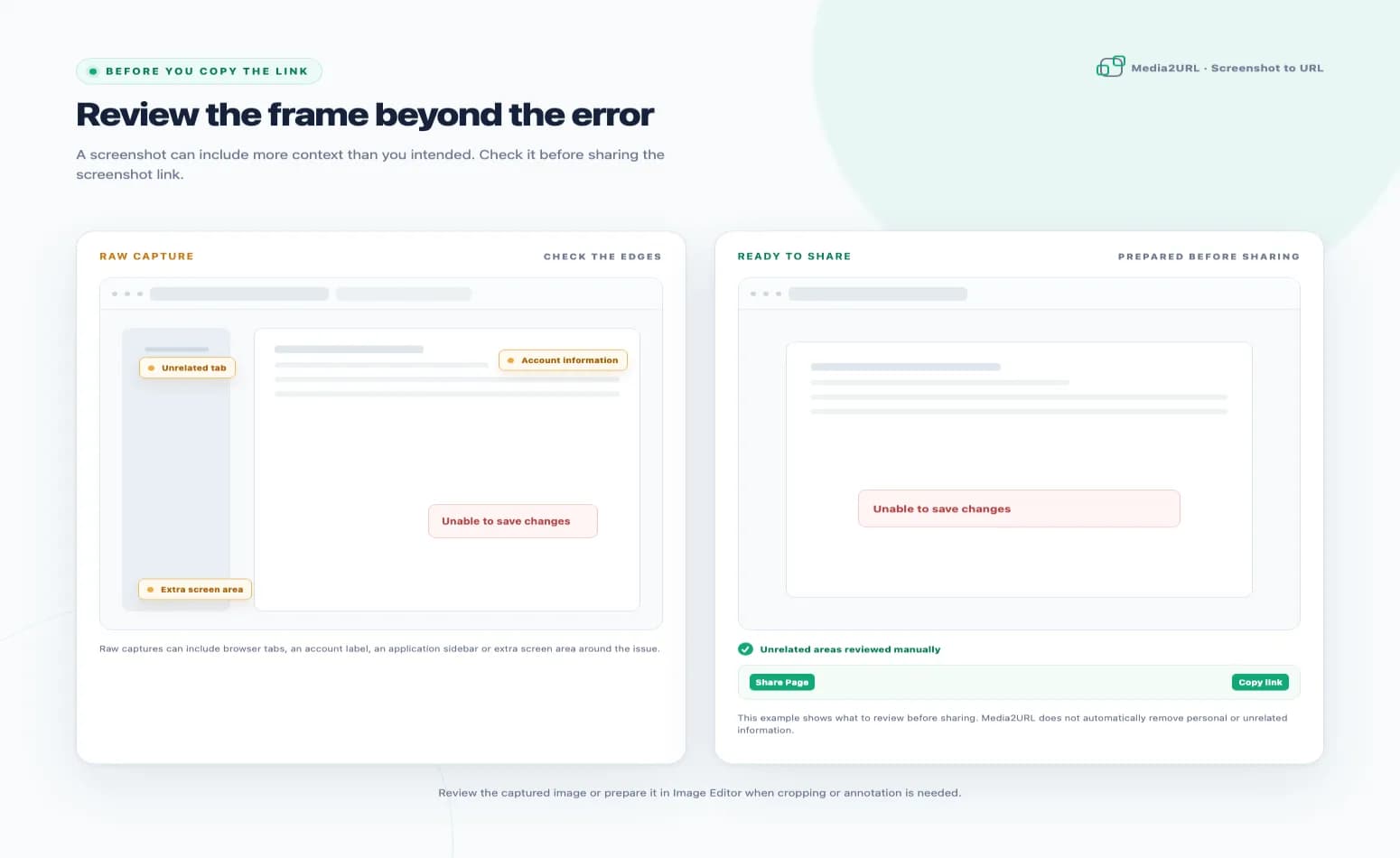
A screenshot taken to explain one error can reveal much more around it. Browser tabs, account names or email addresses may still be visible even though they have nothing to do with the problem you are trying to share.
Review the captured image before copying its link. If only one area matters, capture a smaller window or prepare the saved screenshot in the Image Editor before sharing it publicly.
This example shows what to review before sharing. Media2URL does not automatically remove personal or unrelated information from a screenshot.
Screenshot capture stops after the still image is created
The capture tool takes one still frame from the source selected in the browser permission prompt. After that frame is captured, the screen sharing session ends before the image continues through the screenshot upload workflow.
This means Screenshot to URL is not a screen recorder. It does not record your screen continuously. If several actions or changing states need to be shown in sequence, a short recording may explain the problem better than several unrelated screenshots. See Video to Link when a moving explanation is the better fit.
Not every screenshot needs to stay available indefinitely
Support screenshots are often useful only while one issue is being investigated. When the evidence is temporary, choose the visibility or expiry options available for your account before sending the screenshot link.
After the case is resolved, review whether the link still needs to remain available. Expiry controls access according to the selected setting, but do not treat expiry as automatic permanent deletion unless the product explicitly guarantees that behaviour.
For a shorter-lived image workflow, see Temporary Image Upload.
Expiry
Choose the available duration before sending the link.
Visibility
Use the privacy option that matches the case.
Review
Check the screenshot again when the issue is closed.
A captured or saved screenshot can use the same sharing outputs
When you need to turn a screenshot into a link, start by capturing the visible screen state or uploading the screenshot that is already on your device. Once the image finishes uploading, Screenshot to URL shows the available screenshot link and sharing formats for that file.
The same workflow covers a normal screenshot to link or convert screenshot to URL need. Use the direct screenshot URL when another website needs the image itself, or send the share page when someone mainly needs to inspect the screenshot in a browser.
Keep the capture boundary in mind
Screen capture requires browser permission, cancelling the prompt prevents capture, normal upload limits still apply, and the tool does not automatically insert a generated link into Slack, Google Docs, Microsoft Word or another external application.
Screenshot to URL captures or uploads. Use Image Editor when cropping or annotation is needed.
The browser chooser and available screen, window or tab options can vary by browser and operating system.
Frequently asked questions
Choose Take Screenshot and allow the browser's screen sharing prompt. Select the screen, application window or browser tab you want to capture, then let Media2URL take the still frame and upload it.
After the upload finishes, the result panel shows the available screenshot URL, share page and other supported outputs. You can then copy the format that fits where the screenshot needs to go.
Yes. Open the Upload Image tab and choose the screenshot that is already saved on your device. Once the file passes the normal upload checks, the result panel provides the available screenshot link and sharing formats.
This avoids starting another screen capture when the image already exists.
Yes. Screenshot to URL works with a new browser capture or a screenshot that is already saved on your device. A new capture creates one still image, and that image receives its own screenshot URL just like an uploaded screenshot. The tool does not start a continuous screen recording.
Where the browser's screen sharing interface provides that option, choose the browser tab you want to share instead of selecting the entire screen. Media2URL receives the source you approved and captures one still frame from it.
The available sharing choices can vary by browser and operating system, so the chooser may not look the same everywhere.
The result panel shows the outputs currently supported by the screenshot workflow. These include the Direct URL, Share Page URL, HTML, Markdown, BBCode, Delete Link and QR code. Each displayed output has its own copy control.
No. The capture workflow takes one still frame from the screen, window or browser tab selected through the browser permission prompt. The screen sharing session ends after that frame is captured before the screenshot continues through the upload workflow.
A screenshot captured through the tool is prepared as a PNG. Existing screenshots can also be uploaded as PNG, JPEG, WebP or GIF because those formats are accepted by the current upload policy. File-size and account limits still apply.
A screenshot used for a short support case does not always need to stay available for as long as one kept in documentation. Use the visibility and expiry settings shown for the current account, while private access or other controls only apply when they are available for that plan.
Other media tools
Select another specialized converter to create direct links or share pages for your files:
Image to Link Converter
Upload an image and get a direct image URL or a share page.
Video to Link Converter
Upload MP4, MOV, and WebM videos for direct stream links and browser player pages.
GIF to Link Converter
Turn animated GIFs into direct delivery URLs and shareable browser links.
Bulk Image Upload
Batch upload multiple image files simultaneously and collect link outputs.
Temporary Image Upload
Create image links that expire after a short time, with customizable duration windows.