

Media2URL vs ImageKit: Media Management and Delivery Compared

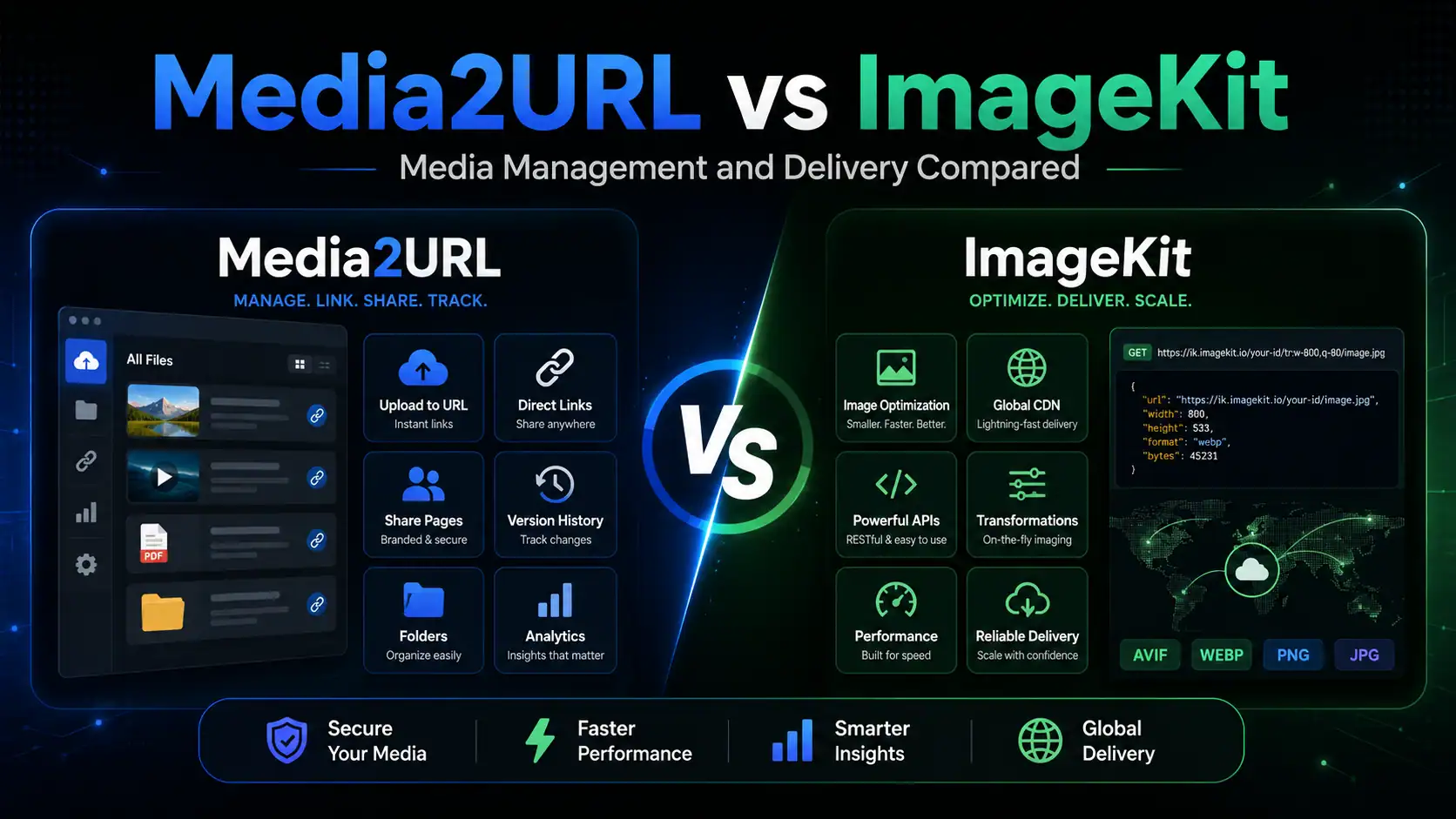
The difference between Media2URL and ImageKit is easy to miss when the job is only uploading a file and copying a link. It becomes much clearer once the same image needs several sizes inside an application, a client needs controlled access to a draft, or a team has to keep hundreds of media files organised across different projects.
ImageKit sits closer to the delivery side of that work. It combines real time image and video processing with a full Digital Asset Management platform, so developers can connect media to websites and applications while content teams work with the same asset library.
Media2URL starts closer to the file itself. Images, PDFs, videos, GIFs and audio can move through a visual workspace where they are organised, processed and shared, with the link remaining connected to access settings and version controls afterwards.
Both products now cover enough common ground that a simple feature checklist does not tell the whole story.
The shortest way to understand the difference
If your difficult problem happens while media is being delivered, ImageKit has the stronger setup. An application can request another image size or crop through the URL, developers have APIs and SDKs available, existing storage can remain connected, and video delivery can extend to adaptive streaming.
Media2URL makes more sense when the difficult part happens around the stored file. A team can organise media in visual workspaces, prepare supported files with the relevant tools, create direct or controlled links, then come back later when a file needs another version or the sharing rules need to change.
There is genuine overlap between the two. ImageKit has a substantial visual DAM rather than being a developer only service, and Media2URL can also produce supported image variations through URL parameters. The difference is how far each product goes in those directions.
ImageKit is built around media that changes during delivery
Consider a product image used in several parts of an online store. The search result needs a small version, the category page needs another crop, and the product page needs something larger.
ImageKit does not require the team to manually save every one of those versions first. A developer can request the required output through transformations in the delivery URL, while the original file stays in the Media Library or a supported connected storage source.
Video follows the same broad idea. ImageKit supports operations such as resizing and cropping, trimming and thumbnail generation. Its wider video stack also covers adaptive bitrate streaming where the application needs that type of delivery.
This developer side is only part of the current product. The Digital Asset Management system includes folders and collections, tags and custom metadata, while saved searches help teams deal with larger libraries. AI visual search adds another way to locate an asset when a filename or tag is not enough.
Permissions can also go much deeper than basic account access. ImageKit supports granular controls around files and folders, accounts and media collections. Comments and audit history sit alongside those controls, and public links can use password protection or an expiry period.
The DAM Agent adds another layer. It can work with asset search and metadata through natural language requests, and it can produce transformation URLs as part of that workflow.
Calling ImageKit only an image CDN would therefore leave out a large part of what the platform now does.
Media2URL keeps more of the work inside the visual workspace
Media2URL takes a different route. A person can upload the file, organise it, make the required changes and choose the final link without building that complete workflow through code.
The Image Editor is a good example. It is built around editable layers rather than acting only as a visual way to construct another transformation URL. Text and shapes can stay separate from drawing elements and image adjustments while the user is still working.
Supported exports include JPEG, PNG and WebP.
The bigger distinction appears when the project contains more than images.
PDF files have their own workspace for tasks such as merging and splitting, page organisation and watermarks, along with numbering and compression. Password and metadata controls are also part of the supported PDF workflow.
GIF tools cover speed changes and reverse playback, with colour compression available as well. Audio Studio handles supported trimming and output settings, including format or bitrate conversion. Video tools cover dashboard based compression and trimming, plus supported extraction workflows.
A team can keep these files inside isolated workspaces rather than mixing every client or internal project together. Members join with one of four roles: Owner, Admin, Editor or Viewer.
The file also keeps its sharing controls close by. Public and Unlisted access are available alongside Private access and password protection. Supported plans and file types can extend this with expiry, view or download limits, access that works once, signed delivery and managed file versions.
Media Migration covers a different kind of job. Instead of bringing in a few isolated URLs, supported existing media can be moved into the workspace as a wider migration workflow.
Media2URL is not limited to manual editing either. Supported images can use URL parameters for another size or crop, fit and position, quality changes and format output. WebP and AVIF are available for supported transformation results.
ImageKit still goes considerably further when those transformations need to run throughout an application.
The overlap is much wider than it first appears
A comparison based on old product categories would put ImageKit on the developer side and Media2URL on the visual uploader side. That split is now too simple.
ImageKit has a mature DAM. It includes asset versions and collaboration, granular permissions and AI assisted discovery.
Media2URL also has a structured library, team workspaces and file history. It adds practical processing tools around several types of media rather than concentrating those deeper delivery capabilities mainly on images and video.
Both can create image variations through URLs.
ImageKit does this inside a mature transformation and delivery system designed to work in real time. Media2URL keeps URL transformations beside a separate layer based editor and its broader file management workflow.
That is the point where the products start to feel different even though several feature names overlap.
Main feature comparison
| Capability | ImageKit | Media2URL |
|---|---|---|
| Main platform focus | Real time media APIs, delivery infrastructure and AI assisted DAM | Visual media workspace, direct file links and dashboard processing |
| Image and video delivery | Global CDN with automatic optimisation | Hosted direct links with managed delivery controls |
| Image transformations through URLs | Extensive resizing and cropping, overlays and AI transformations | Size and crop controls, fit and position, quality and format controls with supported WebP or AVIF output |
| Video transformations | Real time resize and crop, trimming and thumbnails, adaptive streaming | Dashboard based compression and trimming, with supported format or audio extraction |
| Media library | Folders and subfolders, collections and custom metadata | Nested folders and tags, bookmarks and bulk asset actions |
| Search | Advanced filters and saved searches, plus AI visual search | Command search across filenames and tags, along with supported file types |
| AI capabilities | DAM Agent, AI tagging and visual search, plus generative transformations | No separate AI workflow currently included |
| Visual image editor | Visual transformation editor with crop and resize, focus controls and AI edits | Layer based editor with adjustments and drawing, shapes and text, plus stickers |
| PDF tools | PDF storage and delivery with supported page or thumbnail extraction | Dedicated PDF workspace for merge and split, page organisation and watermarks, numbering and compression, passwords and metadata |
| GIF tools | Storage and delivery with supported image transformations | Speed control and reverse playback, plus colour compression |
| Audio tools | Audio files stored and delivered as assets | Audio trimming and output controls, with supported format or bitrate conversion |
| Team access | Granular permissions for accounts and files, folders and collections | Isolated workspaces with Owner, Admin, Editor and Viewer roles |
| Collaboration | Comments and notifications, user groups and public collections | Workspace invitations and role management, plus shared folders |
| Audit records | Asset history and central audit logs | Workspace audit logs with supported CSV export |
| Public sharing | Public asset and collection links with passwords and expiry periods | Public and Unlisted links, plus Private and password protected access |
| Limited access | Signed URLs and public links with a selected validity period | Expiry and usage limits, access that works once and signed delivery where supported |
| File versioning | Full asset versions with restore and version search | Visual file history with overwrite and supported replacement choices |
| Replacement behaviour | Dashboard version uploads clear cached transformations automatically | Managed replacement can keep the published Media2URL link active |
| External imports | DAM uploads from supported cloud sources and connected external storage origins | Media Migration from supported URLs or cloud sources, with duplicate checking and source to new URL mapping where available |
| Link diagnosis | Delivery logs and developer troubleshooting tools | Link Doctor for status and redirects, CORS and content type, plus byte range behaviour |
| APIs and SDKs | Extensive APIs and framework specific SDKs | No public Media2URL API; current workflow remains centred on the dashboard |
| Suitable users | Developers and DAM teams, plus larger media operations | Creators and agencies, support teams and small businesses |
The table shows why neither product can be reduced to one label. ImageKit has far more than a transformation API, while Media2URL has moved well beyond upload and copy URL functionality.
The depth still differs. ImageKit has the stronger real time delivery system and broader SDK coverage, along with AI assisted DAM features. Media2URL puts more kinds of manual file preparation beside the controls around the resulting links.
Follow one image and the difference becomes easier to see
Imagine one product photograph being used across an application.
The search page needs a compact version. A category card wants another crop. The mobile layout needs different dimensions again.
This is where ImageKit feels natural. The application requests the variation it needs instead of asking the content team to create every output beforehand.
The original image still remains manageable through the DAM, so the workflow is not split into a developer tool on one side and a completely separate library for content teams.
Media2URL can also create supported image variations through URL transformations. A person does not have to open the visual editor every time another size is needed.
The difference lies in what surrounds those transformations.
With ImageKit, dynamic transformation sits at the heart of a larger image and video delivery system. With Media2URL, URL transformations sit beside the Media Library, the layer based editor, link controls and processing tools for other file types.
Now change the situation.
A creative agency is preparing a campaign with product graphics, a review PDF and a short video. The team needs separate client workspaces, manual edits and a controlled link after approval.
That work fits much more naturally into the Media2URL workspace model.
Version history is strong on both sides, but the update feels different
Both platforms have proper asset versioning.
ImageKit can create another version when a file with the same name and location is uploaded using the relevant setting. Previous versions can be inspected and restored, and a non current version can also be removed through the dashboard or API.
There is an important cache detail here.
When a new version is uploaded through the ImageKit dashboard, cached transformations for that asset are cleared automatically. It would therefore be inaccurate to say that every ImageKit replacement needs a manual cache purge or a wait for old transformed assets to expire.
Media2URL presents file history more visually.
A user can overwrite the active file, attach another version, keep a derivative or save the result as an independent asset. The published Media2URL link can remain in place when the managed replacement workflow is used.
If the new version turns out to be wrong, an earlier version can be restored.
So version history itself is not the deciding difference. The surrounding workflow is.
ImageKit gives teams finer control over individual assets
Permissions show another clear difference in product design.
ImageKit can assign access at several levels, including the account and individual assets, folders and media collections. Restricted users and user groups can receive different permissions depending on what they are expected to do.
Its DAM also includes comments and notifications. Audit history sits alongside those collaboration tools, which suits teams where different people need different levels of access to specific parts of a large library.
Media2URL uses the workspace as the main boundary instead.
A company can create one workspace for a client, another for an internal project and another for a product team. People are then invited as Owner, Admin, Editor or Viewer.
Workspace invitations use expiring tokens. They can be revoked or generated again when needed.
Supported activity records include uploads and renamed files, metadata edits and member role changes. Owners can export supported audit records as CSV files.
When an entire project is permanently finished, the workspace can also be deleted together with its related records and stored assets.
ImageKit therefore provides more granular asset level permissions. Media2URL keeps the project boundary simpler by placing it around the workspace.
The two image editors come from different ideas
ImageKit has a visual editor inside the Media Library.
A person can choose supported resize or crop settings visually and copy the resulting transformed URL instead of manually writing every parameter.
That editor remains closely tied to ImageKit's transformation system. Paid AI operations extend it with features such as background changes and generative fill while the original asset stays in the library.
Media2URL's editor works more like a canvas.
Text and shapes can remain separate from drawing elements and visual adjustments during the edit. This becomes useful for a support screenshot with callouts, a promotional graphic or another image where the elements themselves still need to be moved or changed before export.
Once the project contains other file types, Media2URL takes a wider manual processing approach.
PDF tools cover merging and splitting, page organisation and watermarks, along with other supported document operations. Video tools handle trimming and compression. GIF and audio files also have their own preparation controls.
That does not make Media2URL deeper in every type of processing. ImageKit has substantially greater depth in real time image and video transformation and delivery.
The distinction is more practical than that: ImageKit goes deeper into automated image and video delivery, while Media2URL gives a person more types of files to work on from the same dashboard.
Sharing controls are closer than they look
Password protection and expiry are not exclusive Media2URL features.
ImageKit allows DAM assets and media collections to be shared through public links with password protection or a selected validity period. Signed URLs can protect private delivery as well.
This works well when an application needs secure media delivery or a DAM team wants to send a collection outside the account without opening everything publicly.
Media2URL handles access around the hosted file.
Public and Unlisted access sit beside Private access and password protection. Supported plans and file types can add expiry, access that works once, view or download limits and signed delivery.
A signed link is useful when somebody should not receive permanent open access simply because they know one URL. It can stop working after its allowed period, and the signing configuration can be rotated when broader invalidation is required.
Media2URL keeps these controls close to the asset after publication too. That becomes useful when the file was shared days ago and the access problem only appears later.
A direct URL can work in a tab and still fail where you actually need it
Media delivery problems are not always obvious.
A video can open normally in a browser but refuse to seek correctly in a player. An image can load directly and then fail inside an editing tool that runs in the browser because the response does not include the expected cross origin headers.
Media2URL's Link Doctor is designed for this type of check.
It can inspect the response status and redirects, content type and CORS behaviour. Byte range behaviour is checked as well.
That last part is especially relevant to video. Players can request only part of a file when somebody jumps forward instead of downloading the whole video from the beginning.
ImageKit approaches troubleshooting through its delivery infrastructure and developer tools.
The Media2URL approach is different. Someone can inspect the URL through Link Doctor without first writing diagnostic code.
Existing media exposes one of the clearest architectural differences
Suppose a company already has a large library sitting in cloud storage.
ImageKit can connect supported external origins such as S3 compatible storage and Google Cloud Storage. The source files can remain where they already live while ImageKit provides supported optimisation, transformation and delivery in front of them.
The media does not have to be copied into a completely new storage system just to use that delivery layer.
Assets can also be uploaded into ImageKit's DAM from supported external sources.
Media2URL Media Migration starts with another goal.
Supported files are brought into the Media2URL workspace. Public URLs or available cloud sources can enter a migration job, with duplicate checking and mapping from each original source to its new URL where that workflow provides it.
This is not a small implementation detail. It changes what migration means.
If the existing storage should remain the origin and another service should sit in front of it for transformation and delivery, ImageKit follows that architecture more naturally.
If the intention is to bring the supported files into Media2URL and continue managing the assets and their new links there, Media Migration follows that route.
Where ImageKit starts to pull away
ImageKit is a strong fit when media behaviour belongs inside the product itself rather than being handled mainly by people through a dashboard.
Four situations make that especially clear:
- Your website or application needs image or video variations generated during delivery through URLs, APIs or SDKs.
- Existing media should remain in external storage while ImageKit handles supported optimisation and delivery in front of it.
- The DAM needs granular asset permissions and deeper search, together with AI assisted workflows and collaboration controls.
- Video delivery depends on real time transformations or adaptive HLS and DASH streaming.
ImageKit can also suit a large content team that cares more about DAM structure than application code. Granular permissions, comments and other collaboration features make it relevant even when only part of the organisation works directly with the developer stack.
Where Media2URL feels more natural
Media2URL fits a team that keeps coming back to the file before and after the URL is created.
That can mean separate client workspaces where media and members stay together. It can also mean preparing a PDF, image, video, GIF or audio file before anything is shared.
Four kinds of work fit especially well:
- Client projects or internal teams need separate visual workspaces where files and members stay organised with their activity.
- PDFs, images, videos and GIFs, or audio files need practical dashboard processing before their links are used.
- Hosted files need direct links alongside supported expiry and limited access, signed delivery and version history, or link diagnosis.
- Existing media needs to move into Media2URL from supported URLs or cloud sources while source to new URL mapping is retained where available.
This also suits creators and agencies, support teams and smaller businesses that do not need to build the media workflow around a large public API and SDK stack.
The useful part is the connection between the library, the processing tools and the controls that remain available after the first link has been created.
So which platform is closer to your workflow?
ImageKit combines a mature DAM with a deep image and video delivery platform. It fits naturally when media is part of the application architecture and the system needs URL transformations, APIs and SDKs, external storage origins or adaptive video.
Media2URL approaches the same broad problem from the asset and link side. Different media types can stay inside visual workspaces, go through their supported processing tools and then be shared through the required link.
The easiest way to separate them is to look at where your team spends the difficult part of the job.
If the difficult part is producing and delivering the correct image or video variation when the application requests it, ImageKit is closer to that work.
If the difficult part is preparing different files, keeping projects organised and continuing to manage those files and links after upload, Media2URL is closer to that workflow.
Neither product needs to be treated as the universal winner. Their feature sets now overlap in several places, but the centre of each workflow is still different.
Comparison review note: This comparison was prepared using ImageKit's official product information and the features available in Media2URL during the August 2026 review. Features, plan availability and usage limits can change, so check the relevant product page when your workflow depends on a specific capability.
Frequently Asked Questions
Is Media2URL a direct alternative to ImageKit?
The two products overlap enough for them to be compared across media hosting, asset organisation and file versions, along with sharing controls and supported image transformations. Media2URL does not replace ImageKit's complete API and SDK stack or its deeper real time delivery system. It becomes a closer alternative when the main requirement is a visual workspace for preparing media and managing the resulting files and links.
Which is stronger for real time image and video transformations?
ImageKit goes much further when transformations need to happen dynamically as part of a website or application. Its platform combines extensive image and video transformations with APIs and SDKs. Media2URL supports image transformations through URLs too, but its broader product remains centred on hosted assets, visual tools and link management.
Why would a team use Media2URL instead of ImageKit?
The reason usually comes from the type of work being done rather than one isolated feature. A team handling images and PDFs, videos and GIFs, or audio can keep those supported files in the same visual account and use the available processing tools before sharing them. For an agency or creator, support team or smaller business, that can be easier than making a public API and SDK stack the centre of the media workflow.
Does ImageKit have a visual image editor?
Yes. ImageKit has a visual editor inside its DAM where supported transformations can be applied without manually writing every transformation parameter. It is closely connected with the ImageKit transformation system and can also use supported paid AI operations such as background changes and generative fill. Media2URL uses a layer based editing model instead, with text and shapes, drawings and visual adjustments kept editable while the user works.
Do both platforms support file version history?
Yes. ImageKit keeps DAM asset versions and allows previous versions to be restored. A dashboard version upload also clears cached transformations for the updated asset. Media2URL keeps managed file history with supported replacement choices. Its managed replacement workflow can keep the published Media2URL link active while the underlying hosted file changes.
How do ImageKit and Media2URL handle existing media?
ImageKit can connect supported external storage origins so the original files remain where they are while ImageKit handles supported optimisation, transformation and delivery. Media2URL's Media Migration workflow focuses on bringing supported files into the Media2URL workspace. Supported migration jobs can include duplicate checking and source to new URL mapping where that capability is available.
Which platform has more dedicated PDF, audio and GIF processing tools?
Media2URL provides dedicated dashboard tools for these file types. The PDF Workspace includes operations such as merging and splitting, page organisation and watermarks, along with compression and other supported document controls. Audio Studio covers supported trimming and output settings, while GIF tools include speed changes and reverse playback, plus colour compression. ImageKit can store and deliver a broad range of assets, but its deeper transformation and delivery capabilities are concentrated on images and video.
Does ImageKit support password protected or expiring sharing?
Yes. ImageKit DAM assets and media collections can be shared through public links with password protection or a selected validity period. Signed URLs are also available for private delivery. Media2URL provides similar access concepts through its own file workflow, including Public and Unlisted access, Private links and password protection, with expiry and other limits available where supported.
Does Media2URL have a public API like ImageKit?
No public Media2URL API is included in the current comparison source. ImageKit provides extensive APIs and framework specific SDKs. That difference becomes important when media operations need to be called directly from application code. Media2URL keeps its current workflow centred on the dashboard and the hosted assets managed there.
Which product has more granular team permissions?
ImageKit uses the more granular permission model described in this comparison. Permissions can be applied around accounts and individual assets, folders and collections. Restricted users and groups can receive different levels of access. Media2URL uses isolated workspaces with Owner, Admin, Editor and Viewer roles. The workspace becomes the main project boundary rather than reproducing ImageKit's finer asset level permission structure.
Can both platforms use signed URLs?
Yes. ImageKit supports signed URLs for private delivery. Media2URL also supports signed delivery where the current plan and file workflow provide it. Other supported controls can include expiry and view or download limits.
What does Link Doctor do in Media2URL?
Link Doctor checks the behaviour of a media URL rather than editing the media. It can inspect response status and redirects, content type and CORS behaviour, plus byte range support. This becomes useful when a direct URL opens normally in a browser but fails inside a player or another browser based tool.
Can Media2URL keep the same published link after a file changes?
The managed replacement workflow is designed so the published Media2URL link can remain active while the hosted file is updated. File history remains available as well, so an earlier version can be restored when the newer replacement needs to be rolled back.